Top 6 Race Permitting Questions Answered
1. Do I need a permit for my race? Contents
- 1. Do I need a permit for my race?
- Mass Gathering Permit
- Special Events Permit
- Private Land Permission
- 2. Who do I contact to get permits?
- Parks and Recreation
- City Officials
- Health Department
- Police Department
- Fire Department
- State Departments
- 3. Will there be inspections related to my race permit?
- 4. How much do race permits cost?
- 5. What information do I need to include in my race permit?
- 6. When should I start the race permitting process?
You have a vision for your race. The next steps are making it reality.
Getting the right permits matters whether you're planning a 5k run, fun run fundraiser, bike race, triathlon, marathon, etc.
And, following the permit requirements and permitting well in advance of your race will get the city’s government departments on your side.
Here are the answers to the top six race permitting questions:
- Do I need a permit for my race?
- Who do I contact to get permits?
- Will there be inspections related to my race permit?
- How much do race permits cost?
- What information do I need to include in my race permit?
- When should I start the race permitting process?
1. Do I need a permit for my race?
Yes – it’s just a question of which types of permits you’ll need. As you assess your permit needs, start with your local city or town office to learn more about how they permit their events.
Typically, the bigger the city the more permits you’ll need. Bigger cities often have a special events permit.
Smaller towns and counties may do their permitting through the police department or sheriff’s office.
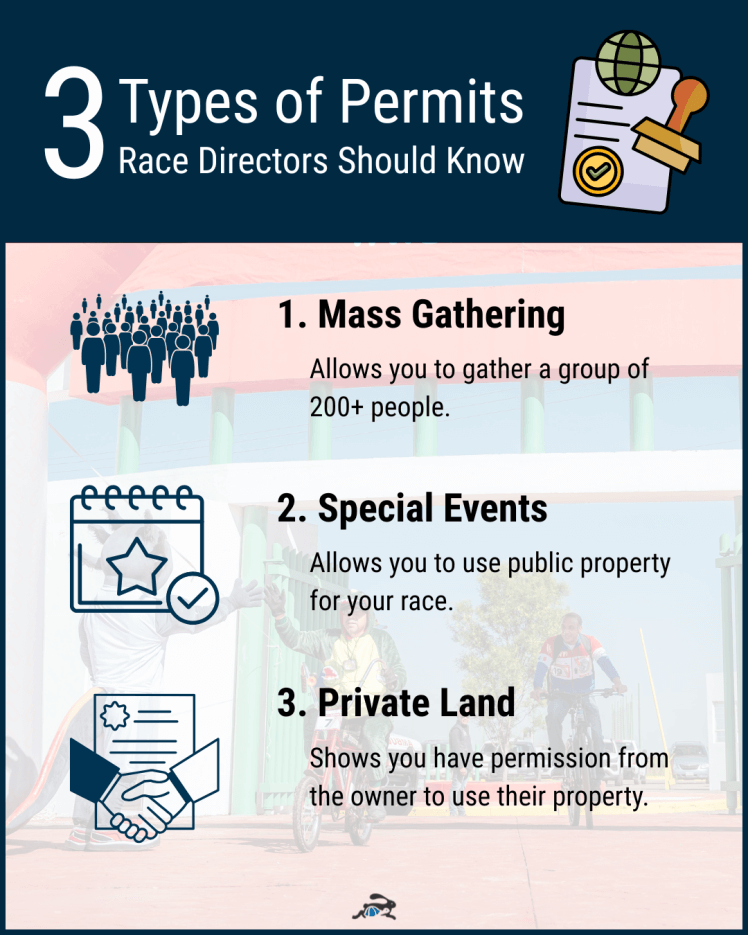
Mass Gathering Permit
All races need a mass gathering permit, even if your course is entirely on private property. These permits are typically offered through the local health department.
For this permit, you’ll need to provide details on restrooms, first aid, trash, and water access.
Special Events Permit
You’ll likely need a special events permit if your course is on public property. This permit typically requires all of the details for your event and liability insurance details. It’s reviewed by all city departments affected by your race.
You’ll typically get the special events permit details from your city or town’s parks and recreation department. If you’re in a smaller town or county, you may get a parade route permit through the police or sheriff’s department instead.
Private Land Permission
For races on private land, you’ll need a permission letter from the owner to show that you can use their property for your event.
2. Who do I contact to get permits?
Start by contacting your local government to learn more about who you’ll need to talk to about permitting. You’ll also need to know who owns the land for your start line, finish line, and each other part of your course. Depending on who owns it, you may need to work with multiple government agencies to get your permits.
Parks and Recreation
Start with the parks department. They’re often the department that focuses on special events. They also typically own and manage public parks. For race courses in public parks, you’ll need to work with the parks and recreation department.
City Officials
Cities may also oversee the permitting process, so you may also need to work with the city manager and other departments in the city – like police, fire, health, etc.
Health Department
The health department typically issues mass gathering permits. So, you’ll most likely work with them no matter where your race is.
Police Department
In smaller towns and counties, you may be working directly with the police department to get all of the permits you need.
No matter the size or type of your race, you’ll likely be working with the police department anyway to ensure safety at your event.
Fire Department
In smaller areas, sometimes the sheriff doesn’t do the permitting. Instead, they are done through the fire department.
State Departments
If your race course uses state roads or state lands, you’ll need to work with state government organizations on permitting – think the state’s park and recreation department, bureau of land management, and the state’s department of transportation.
3. Will there be inspections related to my race permit?
Sometimes the fire marshal, health department, or department of transportation will come inspect your event once it’s been set up to ensure that the safety standards are met and the permit has been followed.
4. How much do race permits cost?
Permit costs have a wide range depending on the city or town’s rates. Permits in smaller areas tend to be cheaper than permits in mid-size cities. And, mid-size cities are cheaper than big cities.
Be sure to check the permit costs as you’re budgeting for your race.
5. What information do I need to include in my race permit?
Specific requirements vary by city and town, but generally speaking you’ll need
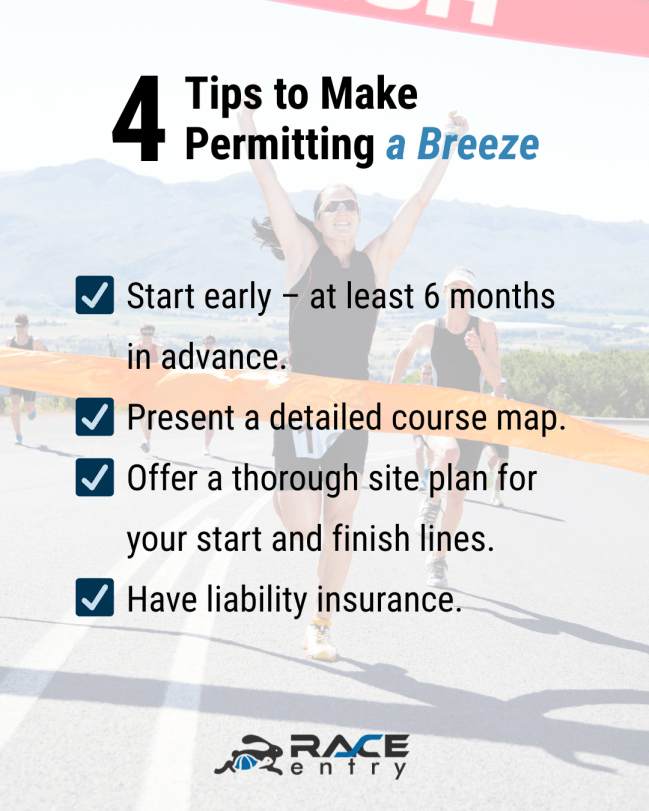
- course map with a predefined route (with toilet placement, trash cans, water access, etc),
- site plan for your start and finish line (toilet placement, garbage location, water access, police spots, etc.)
- certificate of liability insurance,
- release of liability agreement.
Be sure you know your course well – where are there potholes, is there construction, when does the course cross intersections, etc.
Use this information to give the city your plans for managing the course – when and where do you need police officers, how are you going to prevent injuries from a pothole, where will the potties be, where will you put aid stations, etc.
Just as you thoroughly review and plan your course, you also need to do the same for your start and finish line. Where will you put everything to ensure safety and easy crowd control?
When it comes to the details of your race plans, be as specific as possible. Cities need that information to understand what to expect and what resources are needed.
You’ll also need to provide proof of insurance. Often the city, town, or state government will want to be added as additionally insured on your policy.
6. When should I start the race permitting process?
Cities and towns love advance notice, so start the permitting process at least six months in advance. You’ll also want this advance time so you can adjust your plans and preparation as requested by the city. This early start is also particularly important if your race is a longer distance or more complicated like a marathon, triathlon, or bike ride.
If you permit the right way and jump through the hoops your life will be so much easier and the city or town will advocate for you.